I was talking with MasterIO about Yuna, the Discord bot of o!rdr, when I said that I could win big money.
Big money in this story means virtual currency from a Discord bot. Sadly I did not buy a house with JavaScript.
He told me to “win against Math.random”.
So I did what any reasonable person would do. I googled how to break Math.random.
JavaScript moment
Math.random() is not magic. It does not call the universe and ask it politely for a number. It is pseudo-random, which means that it uses an internal state to generate numbers that look random enough for most things.
The important part is “most things”.
If you use it to choose a random color, it’s fine. If you use it for an economy system where people can gamble all their credits, perhaps it is time to sit down for a minute.
I remembered watching a video about predicting V8’s Math.random() a while ago, but I forgot the details. After some googling I found the repository of said video: PwnFunction/v8-randomness-predictor, which does the hard work with Z3 and some xorshift128+ witchcraft.
So, credit for the actual prediction tool goes to PwnFunction. I was mostly the guy holding a Discord command and asking “what if”.
A very generous roll command
Yuna has a command called y!roll. Like many roll commands, you could ask it to roll a random number.
The small problem was that there was no useful limit.
This meant I could ask Yuna to roll with a very big maximum value. Since the bot probably did something like this:
| |
the result leaked a lot of digits from the original random float.
With a small max, the result is too imprecise to be useful. With a huge max, the roll result keeps much more precision from the original Math.random() value. And precision is exactly what the predictor needs.
Computer science happened here
The plan became:
- roll a very big number
- recover a part of the original random float
- do it a few times
- predict the next
Math.random()values
In practice, I used y!roll enough times to recover useful outputs from Math.random(). Then I converted the roll results back into floats close enough for the predictor.
The predictor takes a few outputs, gives them to Z3, and Z3 solves the internal state of the generator. This is the part where I will spare you the ritual because it mostly looks like math symbols bullying JavaScript until JavaScript confesses.
After around 5 values, I could predict the next random numbers.
Nice.
Gambling time
The next step was to connect this to y!bet.
I did not have the bot source code in front of me, but the behavior was easy to guess. The command probably used Math.random() and compared it to a threshold, something like:
| |
So if I could predict the next Math.random() value, I could know if the next bet would win or lose.
If the next number was bad, I just called y!roll again to advance the random generator. If the next number was good, I could bet. If the next number was very close to 1, then it was time to be financially irresponsible with fake money.
I first tested the prediction with a roll. It matched.
Then I tested with a small gamble and lost something like 20 credits on purpose. It also matched.
Then I went almost all in.
And won.
The real enemy
There was one funny problem. The predictor only works if I know exactly how many times Math.random() was called.
So if someone, in a random Discord server, typed y!roll between my prediction and my bet, the whole thing could become desynchronized. Same thing if someone used another command that called Math.random().
The attack was not only against pseudo-randomness. It was also against people being bored on Discord.
Imagine losing everything because someone somewhere rolled a dice at the wrong time. Beautiful.
The fix
The fix was very simple:
Cap y!roll to 1,000,000.
With a small enough maximum value, the command does not leak enough precision from the raw Math.random() output to recover the internal state.
Of course, the better lesson is to not use Math.random() for anything that behaves like gambling or money, even if the money is fake. Use a better randomness source, don’t expose raw-ish random outputs, and don’t let every command share one predictable stream of future sadness.
tl;dr
Math.random()is not secure randomness- Unlimited
y!rollleaked too much information - V8 randomness can be predicted if you collect enough outputs
- PwnFunction/v8-randomness-predictor did the solver magic
- I used rolls to know when
y!betwould win - I won fake money
- MasterIO fixed it by capping
y!roll
Update, July 2026
My friend Freakish and I were not ready to let this go. The 1,000,000 cap was supposed to be the fix. We wanted to know: was it actually enough?
The thing about capping the roll is that it sounds like it kills the attack. And it does, if you are using the original predictor. The problem is that 1,000,000 still leaks roughly 20 bits of entropy per roll. That is way less than the 52 bits you get from a raw Math.random() float, but it is not zero. Stack enough of those 20-bit leaks together and you can still reconstruct the internal state. You just need a smarter tool.
The AI revolution, sort of
Being in the middle of the AI revolution, we did what anyone would do: we asked some LLMs for help. We fed them the problem and asked them to reimagine PwnFunction/v8-randomness-predictor to work with less precise inputs. Specifically, could it predict the next numbers from a sequence of integers in the 1-to-1,000,000 range instead of near-exact floats?
The LLMs gave us a starting point. A working, functional, horribly slow starting point.
How it actually works under the hood
Remember xorshift128+? Same engine as before, same 128-bit state hiding behind Math.random(). V8 generates numbers in batches of 64 and serves them backwards, so the first number you see is actually the last one that was computed. All of that still applies.
The difference is precision. The original predictor worked because big rolls leaked most of the 52-bit float. With a cap of 1,000,000, you only get about 20 bits per observation. That is like trying to solve a jigsaw puzzle where each piece only shows a tiny corner of the picture.
So we modeled the whole thing in Z3 again, but this time with inequality bounds instead of exact values. Each roll of $r$ tells us the original float fell somewhere in a range:
$$\text{lower} = \frac{(r - 1) \cdot 2^{52}}{1{,}000{,}000} \le \text{mantissa} < \frac{r \cdot 2^{52}}{1{,}000{,}000} = \text{upper}$$
That is a lot less information per roll, but Z3 can still work with it. You just need more observations and a smarter search.
The other problem was figuring out where in V8’s cache we started listening. Since the batch of 64 values can be partially consumed when you begin observing, we simulate two full batches (128 states) and slide through all possible offsets $k$ (from 0 to 63) until the cache boundary clicks into place.
Freakish did the hard work
The first version worked. It was also so slow that you could go make coffee between rolls. Freakish then spent an unreasonable amount of time optimizing it until it was fast enough to use in practice. The kind of fast where you can predict, roll to advance the stream, and place a bet before anyone notices what happened.
So we did exactly that.
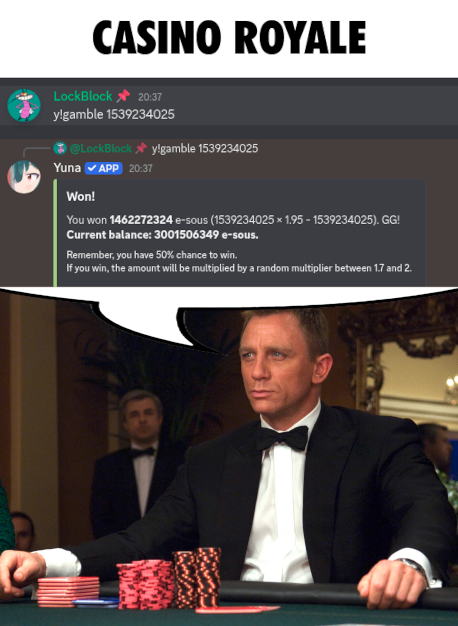
The 1,000,000 cap slows the attack down, but it does not kill it. As long as Math.random() is the source and you can observe enough outputs, the internal state is recoverable.
Of course, the real lesson has not changed: do not use Math.random() for anything that looks like gambling or money, even if the money is fake. A capped leak is still a leak.